Binomial (Terran): Regeza magnes
Common (Terran): The Virtues
Self-Designation: Ansale'wit [gestural/network; phonetic approximation]
Biochemical Basis: Carbon-water, chitin-analogue structural polymer, chemosynthetic metabolism
Body Plan: Fungal colonial; metamorphic frame-builder
Cognitive Architecture: Distributed electromagnetic network (substrate-coupled broadcast)
Homeworld: Regez (Tidally locked super-Earth, red dwarf system)
Federation Status: Full member, pre-contact spacefaring (generation ship diaspora)
Uplift Status: Self-achieved (independent spacefaring prior to federation contact)
If you are about to meet an Ansale'wit and have thirty seconds: Fungal network organisms that build humanoid-looking bodies the way we build cars: to get around in. The body is a vehicle. The person is the fungal core and the electromagnetic field it produces. They are chemosynthetic (powered by geological chemistry, not sunlight), native to a tidally locked super-Earth whose entire crust is riddled with caves, and their cognition is distributed across a planetary-scale fungal network that uses rock, air, and water as transmission media. When connected to this network, they think thoughts that are literally bigger than any individual could produce alone. When disconnected, they function but diminish, like a computer cut off from the internet.
They are diaspora. Their homeworld was colonized by a Species #0 lifeform that strip-mined their neural infrastructure without realizing it existed, and then turned to hostilities after they did realize. They fled in living generation ships grown from their own substrate. They have been looking for home ever since, and the question of whether "home" still exists in any meaningful sense is the defining political argument of their civilization. It is very likely that your translator equipment, or anything else with radio receiving equipment, will pick up on their thoughts.

¶ COMMON DESIGNATION AND PRONUNCIATION GUIDE
Ansale'wit (ahn-sah-LEH-wit), with a glottal stop before the final syllable.
The name is their own, adopted by the federation at large. It translates, depending on which Ansale'wit you ask and which network they're connected to at the time, as "the people who are the land" or "those who think through the ground" or, in one memorable phrasing from a shipboard dialect, "the ones whose thoughts have roots."
Binomial: Regeza magnes ("the magnet of Regez"). Named for the electromagnetic fields they generate as a byproduct of cognition. Early federation xenobiologists assumed the fields were a communication mechanism, but they're closer to breathing - involuntary, continuous, and very difficult to suppress.
Human common names in informal use: "Caps" (from the peaked antenna structure; considered mildly rude), "Treenet" (from the fungal network; tolerated but reductive), "Mushroom people" (deeply inaccurate and they will correct you).
¶ BIOLOGY

¶ The Image
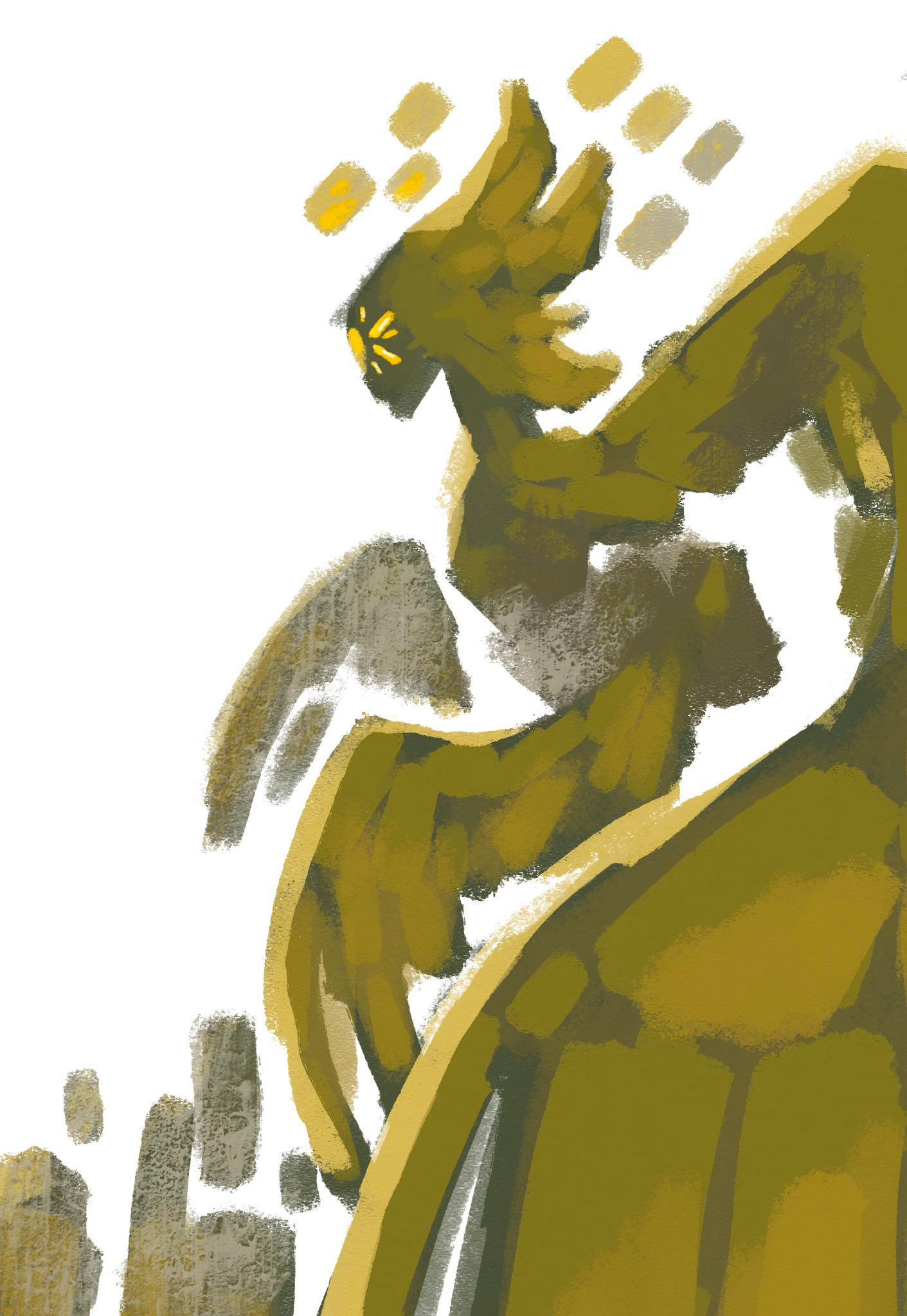
The figure in front of you - bipedal, roughly human-sized, robed, with that distinctive peaked cap and the faint red eyespots - is not the Ansale'wit. It is the Ansale'wit's Image: a structure of chitin-analogue polymer grown by the organism to interact with the physical world. The actual organism is a fungal network - a mass of electrically conductive hyphae threading through the Image's interior like mycelium through soil. The Image is a vehicle, and the peaked cap is an antenna. The red eyes are backup sensors for a species whose primary sense is electromagnetic.
The Ansale'wit term for this body is variously translated as "Image," "Photograph," "Avatar," or "Incarnation." "Image" is the most commonly used by Ansale'wit ambassadors and the standard in this document.
An individual Ansale'wit can, given sufficient time and metabolic resources, withdraw from one Image and grow an entirely different one. The process - cocoon-mediated metamorphosis - is metabolically expensive and leaves them totally vulnerable for weeks to months, so most don't bother, but the option is always there. Their humanoid shape is a choice, selected for mechanical utility, but hexapodal forms, as well as more purpose-built frames, are not infrequent.
¶ The Organism
The Ansale'wit's actual physical body is a vein-like network of conductive hyphae-analogue threads with clusters that form a spongy, wet "slime mold" at intersection points such as where limbs meet central torsos. Coloration is typically white, black, red, or yellow, and depicts biological lineage. The interior of an Image's torso and head are typically filled with the highest concentration of this slime mold.
The structural tissue is a chitin-analogue - tough, flexible nitrogen-containing polysaccharide, similar in principle to insect exoskeleton or crab shell - doped with metallic ions (iron, copper, zinc) drawn from the mineral-rich hydrothermal environment of their homeworld. The conductivity is load-bearing: it allows their EM-based cognition to propagate at speeds necessary for complex decision-making and movement over human-comprehensible timespans.
The internal medium of an Ansale'wit, both Image and core, is a hydrated gel matrix, consistency roughly comparable to the inside of a fresh mushroom. The fungal core threads through this gel the way tree roots thread through soil. Nutrients, signals, and metabolic byproducts move through the gel matrix, processed by the hyphal network as they go.
¶ Biochemistry
Carbon-based, water-solvent, chemosynthetic. Their ancestral metabolism extracts energy from the chemical gradient between hydrothermal fluids and ambient water, the same energy source that powers deep-ocean vent ecosystems on Earth. Their homeworld is volcanically hyperactive with a crust that's basically a sponge full of hot mineral water, so this energy source is everywhere. Ansale'wit obtain energy through warm mineral water baths, and find the addition of a mild electrical current to be stimulating and useful for general health. Ansale'wit, despite being functionally fungoid, do not photosynthesize at all.
The Image's metabolic demands are substantial. Maintaining a large, mobile, cognitively active Image requires continuous chemical energy input. Extended disconnection from nutrient sources results in progressive Image degradation as the organism begins cannibalizing non-essential structure to maintain cognitive function. The organism prioritizes its own survival over the Image's integrity - if resources become scarce, the Image is the first thing to go.
¶ Sensory Architecture
Primary sense: Electromagnetic perception. The fungal core generates EM fields as a byproduct of its electrochemical activity, the same way human neurons produce faint electrical fields when they fire, except amplified by evolution and conducted through metallically doped tissue. These same tissues detect incoming EM signals, allowing the Ansale'wit to perceive the world as an electromagnetic landscape.
This is more analogous to proprioception - the sense that tells you where your own body parts are without looking - than echolocation. Ansale'wit feel the EM properties of their surroundings analogously to the way humans feel the position of their own hands or noses. On their homeworld, where the atmosphere is conductive and the ground is threaded with mineral-laden water, EM signals propagate through every medium - air, rock, and water. They perceive the world as a three-dimensional field of electromagnetic activity, continuously and without additional effort, functionally for free.
The implications for interaction: they can sense your electronics. Your translator implant, your Pinto, any device that generates an electromagnetic field is visible to them in the same way a high-visibility vest is visible to you. More importantly, they can sense each other - not as visual shapes but as EM signatures, recognizable the way voices are recognizable to us. In a room with five Ansale'wit, each one is generating a unique electromagnetic pattern that the others perceive directly. They are, at all times, faintly aware of each other's cognitive activity. This is an involuntary communiqué more akin to being able to "read a room" than true telepathy - like being able to hear everyone in the room breathing, and being able to tell from the breathing alone whether someone is calm, agitated, focused, or asleep.
Secondary sense: Chemoreception. Distributed across the hyphal surface. They taste the air and ground continuously. Used for environmental assessment and close-range social signaling, as well as nutrient detection. Comparable to but more sophisticated than a human sense of smell/taste.
Tertiary sense: Vision. Ansale'wit Images possess eyespots that relay visual information to the fungal core. Ansale'wit have excellent red-spectrum and infrared vision, and terrible vision for everything above green, with blues, purples, and ultraviolets usually being totally invisible to them. Offworld Ansale'wit often grow Images with more developed eyes than their homeworld counterparts bother with, because station environments don't conduct EM signals the way Regez does and eyesight becomes useful. If the Ansale'wit you're talking to has notably large or complex eyespots, they've probably spent significant time offworld.
¶ Lifecycle
The Ansale'wit lifecycle does not follow the linear birth-maturity-death trajectory that humans consider default.
Germination. New individuals emerge from reproductive events as small, frameless organisms - patches of hyphal network rooted in substrate. At this stage they are sessile, network-connected, and cognitively active but physically immobile. Germination-stage Ansale'wit think, communicate, and develop personality entirely through the network. They do not have bodies. They don't need them yet.
First Framing. When an individual has developed sufficient cognitive complexity and accumulated enough metabolic reserves, they undergo their first metamorphosis into a mobile Image. This is a major life event, culturally significant, roughly analogous in emotional weight (though not in mechanism) to human puberty. The choice of first Image is shaped by community, environment, and personal inclination.
Mobile Phase. The majority of what humans would call an "adult lifespan" is spent in mobile Images - exploring, working, relating, contributing to community life. Image changes during this phase are possible but uncommon; most individuals settle into a preferred form and maintain it for decades or centuries. The mobile phase is when reproduction, partnership, travel, and creative work primarily occur.
Rooting. Some individuals, typically but not exclusively elders, choose to root permanently - abandoning the mobile Image and integrating directly into the planetary or local substrate as sessile network infrastructure. This is not death, retirement, or decline. It is a transition to a different mode of existence. (See The Elders, under How They Think.)
¶ Reproduction
Spore dispersal: The baseline. An Ansale'wit produces spores - hardy dormant packets of genetic material - that disperse through atmosphere, water, and substrate. A spore that lands somewhere favorable germinates into a new hyphal network, eventually develops local cognition, and may build an Image. Spore-offspring are genetically novel (sexual recombination happens semi-randomly with nearby spores during sporulation) but start with no inherited memory or personality, shaped instead by their genetics and by whatever network they grow into.
Cross-pollination: The social mode. At organized gatherings - pollen galas - Ansale'wit selectively exchange reproductive material: spore-like packets optimized for partner-to-partner transfer rather than wind dispersal. This allows specific individuals to contribute genetic material to offspring with precision that random spore dispersal doesn't offer. The packet itself is generally indistinguishable from the fungal core - a blob of slime-mold-like material that is extracted from the torso of the Image and mixed with the material of the other partner(s). The resulting packet develops a thin, protective membrane, and is carried somewhere on the body of the Image agreed to be most receptive to parenting.
The selection of pollination partners is culturally significant, socially negotiated, and very much a community affair. Cross-pollination galas are part matchmaking festival, part diplomatic summit, part block party. The community has opinions about who should pollinate with whom. The community's opinions are, as with everything in a network society, not private. Novel reproduction at pollen galas is typically selected for compatible strangers rather than loved ones or known relationships.
After reproduction, Ansale'wit do not practice individual parental care.
Network propagation: The strange one. When an individual's signal has been present in a network long and strongly enough, the substrate itself develops persistent electrochemical patterns that echo their cognitive signature. If the individual dies or permanently disconnects, the patterns remain, and can be picked up by new spores both from dispersal and cross-pollination. The term for this translates as "Archival," "Storytelling," or "Possession," and expresses itself in the form of vague past-life memories and instinctual, inexplicable knowledge, although for all intents and purposes the born individual possesses no continuity of consciousness with the propagated individual. Sufficiently large individuals can propagate through any number of offspring, until the signal degrades.
¶ HOW THEY THINK
¶ The Network
Every Ansale'wit in a room is broadcasting all the time, in a way they have no ability to stop or suppress. Their cognitive processes generate EM fields the way a running engine generates heat. These fields propagate outward through whatever medium is available - air, for the atmospheric layer; any conductive surface or substrate they're in physical contact with, for the substrate layer.
Where these signals overlap, interference patterns form. Constructive interference when multiple individuals are thinking along similar lines - signals reinforcing, producing something louder and more coherent than any individual could generate. Destructive interference when they're in conflict - signals dampening, producing cognitive static. The network is an emergent property of multiple EM-generating organisms sharing a conductive medium.
On their homeworld, the medium is the entire planet. Fungal hyphae threading through the porous crust carry signals at high bandwidth over moderate distances. The conductive atmosphere carries signals at light-speed over line-of-sight. Mineral-laden water carries signals through the hydrological cycle. Every surface, fluid, and gas layer is a transmission channel.
In a federation station, the medium is much smaller. A substrate garden - maintained in Ansale'wit-hosting facilities the way wheelchair ramps are maintained in human-accessible facilities - provides a patch of conductive fungal substrate that visiting Ansale'wit can connect to. Additionally, Ansale'wit have found human radio broadcasting infrastructure to be a perfectly acceptable substitute (but disdain digital photography for reasons too complex for this document). This allows networked cognition between present individuals. Without it, each Ansale'wit is operating on local processing only: functional, but diminished. It is roughly comparable to being in a room that is totally quiet for the first time - no air conditioning, no creaking of the house, no wind, no music, no computer humming.
¶ Individual vs. Network Cognition
An Ansale'wit disconnected from any network is still a person, with memories, personality, preferences, and the ability to make decisions and experience emotions. Despite being fungal, Ansale'wit are strikingly individualistic, maybe even more individualistic than Humanity proper.
Their local processing - the fungal core within the Image - handles what a human brain handles: sensory integration, motor control, personality, immediate cognition. What it doesn't handle is the extended cognition that comes from network participation. On the network, an Ansale'wit has access to distributed processing - contributing to and drawing from a shared cognitive medium that amplifies capacity the way a library amplifies an individual's knowledge without making them omniscient. You can imagine, also, that each book in the library is whispering its contents quietly.
Long-term network disconnection is psychologically deleterious. The clinical term used in federation mental health contexts is signal starvation. Symptoms include cognitive dulling, emotional flattening, identity instability, and what Ansale'wit describe as "thinking into walls" - the sensation of reaching for cognitive resources that aren't there, repeatedly, the way an amputee reaches for a phantom limb.
¶ The Elders
When an Ansale'wit ceases mobile life and roots into the substrate, they enter the established phase. The fungal core withdraws from its Image, extends into the surrounding rock, and grows. And grows. And grows.
A fully established elder can extend kilometers of hyphal network through a cave system, with a central mass tens of meters across. Their cognitive capacity scales with mass: more tissue, more processing, more bandwidth. They become network hubs - routing centers where signal from hundreds or thousands of mobile Ansale'wit converges, is processed, and is redistributed. They typically pick a single Image, designed not for mobility but for symbolic and functional means, and begin the process of slowly winding down the personalities of their existing individual Images, akin to an elderly human retiring.
Additionally, elder Ansale'wit visibly glow. The metallic-ion-doped chitin-analogue tissues emit photons when sufficient current flows through them - electroluminescence, the same physical process that makes LEDs work. A mobile Ansale'wit's fields are detectable only by other Ansale'wit and sensitive instruments. An established elder's fields are strong enough to produce visible light. The bigger and more cognitively active they are, the brighter they shine.
The pre-colonial governing structure - the Council of Four Directions - consisted of four such elders, each rooted into a different environmental zone: Sunward, Darkward, and two Terminator positions. They coordinated the planetary network the way major internet exchange points coordinate data traffic. They aided in clarification rather than directly ruling over subjects - their massive cognitive capacity allowed them to find consensus patterns in the network faster than the patterns would emerge on their own.
¶ HOW THEY TALK
¶ Signal, Gesture, and the Etiquette of Noise
Electromagnetic layer (involuntary). Always on. The EM field generated by cognitive activity, perceivable by other Ansale'wit as a signature "hum." This is presence, rather than speech - the equivalent of body heat, or the sound of someone breathing in a quiet room. It conveys mood, alertness, cognitive load, and general state. This is difficult to penetrate with external equipment, but not impossible, although it is generally considered rude.
Gestural/chemical layer (deliberate). Targeted communication between individuals. On Regez, this involved modulated EM signals directed through substrate or atmosphere - essentially, shaping the involuntary field output into structured patterns. In federation contexts, this is often supplemented or replaced by physical gesture, body posture, sign language, and chemical signaling (subtle emissions detectable by their chemoreception).
Auditory layer (deliberate). As sophonts with physical presence and bodies capable of operating on human timescales, Ansale'wit are capable of noisemaking. Ansale'wit do not have vibroreception or an auditory sense, so auditory communication is for your benefit, not theirs. They are, tangentially, also capable of operating keyboards, both mechanically and through electromagnetic means should the keyboard be equipped with an Ansale'wit-positive transductive antenna.
What counts as rude: Generating EM noise in an Ansale'wit space. Running unshielded electronics at high power. Filling a room with what, from their perspective, is the cognitive equivalent of someone shining a strobe light in your face while you're trying to have a conversation.
What counts as intimate: Deliberately dampening your EM output is cognitively expensive - like holding your breath. An Ansale'wit who dampens their signal in your presence is making an effort to give you a quieter environment, which is a courtesy. An Ansale'wit who stops dampening in your presence - who lets you (or your equipment) perceive their full unfiltered cognitive noise - is letting you hear them think. During intimacy, Ansale'wit Images become less cognitively active. Shared mineral water baths are not considered intimate behavior - it's more efficient for several Ansale'wit Images to soak at once, since waste material from one may be useful nutrients for another. Human skin waste (oils, flakes, detritus, etc.) is not nutritionally necessary but is occasionally considered "interesting tasting" by individual Ansale'wit.
What you'll misread: The peaked cap bobbing or tilting. This is not a nod. The cap is an antenna and its orientation affects signal reception. An Ansale'wit tilting their cap toward you is not agreeing with you, but they may be trying to hear you better. An Ansale'wit tilting their cap away from you is not necessarily disagreeing with you, but may simply be trying to focus on a different signal.
¶ HOW THEY BUILD
¶ Fungal Biotech: Growing Instead of Assembling
Their technological paradigm is directed biological growth: using precise control over hyphal extension to grow structures from the molecular level up. Where humans smelt ore, machine components, and bolt things together, the Ansale'wit seed substrate with specialized hyphal strains, supply the right chemistry, and wait. What emerges is a structure with no joints, no seams, no discrete components - a single continuous organism shaped for a purpose.
The engineering strength is in functionally graded materials: structures where properties vary continuously through the object. A single Ansale'wit-grown structural element might be rigid at its core, flexible at its surface, electrically conductive along one axis, and thermally insulating along another, all as one piece. No lamination. No composite layering. The hyphal network that built it deposited different minerals at different locations with cellular precision.
The engineering weakness is the inverse: no modularity. If it breaks, you can't swap in a replacement part because there are no parts. You have to regrow the damaged section from adjacent living tissue, which takes time and metabolic resources. Human-style interchangeable components strike Ansale'wit engineers as an elegant solution to a problem they find philosophically alien: why build a thing out of pieces that don't know about each other?
In practice, the most successful multispecies engineering projects use both paradigms. Ansale'wit-grown substrate for high-performance core systems. Human-designed modular interfaces for anything that needs maintenance by non-Ansale'wit hands. The combination is genuinely better than either alone, which is one of the quiet success stories of the federation's first century that nobody writes about because functional engineering partnerships aren't dramatic.
¶ Architecture
Subtractive, not additive. Ansale'wit cities are carved into existing geology - ravine walls, cave systems, lava tube interiors - rather than built up from components. The fungal network threads through the walls of these carved spaces, serving simultaneously as structural reinforcement, communication infrastructure, and environmental control. The walls regulate temperature and humidity through metabolic activity. The glowing traces of the network are visible through translucent mineral deposits.
The effect is of being inside a living thing. This is because you are.
Visitors to Ansale'wit-built spaces consistently report two things: first, that the architecture feels warm in a way that has nothing to do with temperature (the walls are metabolically active and radiating at biological frequencies); and second, that they feel watched. They are not being watched. They are being perceived - the network in the walls detects their EM signature the way a spider's web detects vibration, and the ambient cognitive activity of the network shifts slightly in response to their presence. This is not surveillance. It's the building noticing you walked in.
¶ Textiles
Ansale'wit utilize clothing for ornamentation, decoration, and modesty. They have a strong tradition of textiles, typically spun from biomechanical devices designed to turn nutrients and minerals into thread, analogous to a purpose-grown silkworm or spider. Ansale'wit textiles are usually metallically doped so as to not impede signal transmission.
¶ Signal-Based Computing
Their computers are biological. Grown from modified hyphal tissue, powered by chemosynthetic metabolism, processing information through EM field interactions in a three-dimensional substrate matrix. The operator doesn't look at a screen. The computer's output merges with the operator's cognition through signal overlap. Using an Ansale'wit computer feels, reportedly, like thinking slightly harder thoughts. Efforts to build human-accessible interfaces for Ansale'wit computing systems are ongoing but limited by the fundamental mismatch: their machines talk in EM fields and do not have screens, and we don't hear or speak EM fields and usually rely on screens.
Compatibility note: Ansale'wit cognitive activity is detectable on human radio equipment. Their "tree wifi" - the leakage of networked cognition into radio-frequency EM bands - is broadband noise to us, but it's noise that can be recorded, analyzed, and with sufficient processing, partially decoded. This has obvious privacy implications. In multispecies spaces, this means every Ansale'wit is walking around in the knowledge that anyone with a radio receiver can hear them think, which is partially why cultural recommendation is to electromagnetically shield your equipment in multispecies spaces with Ansale'wit.
¶ HOW THEY RELATE
¶ Social Structure: Privacy as Achievement
Among themselves, Ansale'wit baseline social reality is low-level mutual awareness. Within a local network - a group sharing common substrate - everyone knows roughly what everyone else is feeling, the way you can read a room's mood without anyone speaking. The hum of a dozen overlapping signal footprints creating an interference pattern that conveys group state.
Privacy, in this context, is a skill rather than a default. Dampening your signal enough to prevent your cognitive state from leaking into the shared medium requires active effort and is cognitively taxing. An Ansale'wit who maintains strong privacy boundaries is doing something closer to holding a difficult yoga pose than to closing a door. The effort is visible to other Ansale'wit, which means that the decision to be private is itself public information, which is useful in a game theory sense.
This produces a social dynamic that has no precise human equivalent. The closest comparison: imagine living in a small town where everyone can tell when you're upset but nobody knows why, and the act of hiding that you're upset is itself conspicuous. The Ansale'wit have built an entire civilization's worth of social norms around navigating this condition, and those norms are sophisticated, nuanced, and almost entirely invisible to human observers who don't understand what the ambient EM environment is telling them.
¶ Kinship and Bonding
Ansale'wit relationships exist on a spectrum defined by signal interaction.
At one end: two individuals in the same network whose signals overlap minimally. Acquaintances. They're aware of each other's presence, can communicate deliberately, share the ambient texture of the network, but their cognitive patterns don't significantly interact.
At the other end: individuals whose signals have interacted so long and so deeply that their interference patterns have become a stable feature of the local network. Their combined signal is a thing that exists in the medium - not a merging of selves, but a standing wave that neither could produce alone. In the Ansale'wit sense, this is a partnership, although it is not necessarily an intimate one. This can involve mentorships, friendships, or rivalries.
¶ Identity
An Ansale'wit's identity is not fully contained in their body. What they experience as "self" includes their signal footprint - the recognizable pattern they produce in whatever network they're embedded in. Same core signal, but different expression depending on network context. This is neurological rather than a performance or code-switching: the them-on-this-network is a genuinely different cognitive entity from the them-on-that-network, in the same way that plural humans express as genuinely different individuals within the same body, but highly exaggerated.
To an Ansale'wit, this is generally considered "travel"; you go to a new place, you become the you-of-that-place, and when you come home, you become the you-of-home again, but neither identity has primacy over the other, but is rather an expression of "you." We believe this is why the term "Avatar" or "Incarnation" is generally interchangeable with "Image" or "Photograph."
For humans attempting to build relationships with Ansale'wit, this produces a specific challenge: the person you bonded with on Station A is not exactly the person you'll meet on Station B. The same core signal, with different interference patterns, produces a noticeably different emergent personality. While they will remember and have continuity of experience, they will present a notably different face to you, and the same Ansale'wit may have a different relationship to you depending on the context you encounter them in.
What does commitment mean when the self who committed is context-dependent? What does consent mean when the self who consented is, in a measurably real sense, not the same self you'll encounter tomorrow in a different location?
The Galloway framework treats this as a philosophical problem to be resolved through clearer definitions. Carver's position is that it is simply a condition to be navigated. Editorial is not taking sides.
(For detailed guidance on interspecies relationships with Ansale'wit, including consent frameworks, physiological compatibility notes, and practicalities, see the supplementary volume: Carver, A., "Interspecies Relationship Protocols: Ansale'wit," IRB-7, 3rd revised edition.)
¶ HISTORY WITH US
¶ The Colonization
The Ansale'wit are indigenous to Regez. Not "indigenous" in the human sense of "first to settle," but rather indigenous in the sense that their fungal network is part of the planet's geological operating infrastructure. Their removal from Regez is less like an expulsion of a human population and more like an ecological catastrophe, combined with a planet-cracking or a glassing, combined with an expulsion of a human population.
The colonizing species, no longer apparently extant but categorized as a Species #0, arrived, found Regez's cave systems rich in minerals and geothermal energy, and began extraction. In doing so, they destroyed sections of the fungal network. At first, this was nonmalicious and nonintentional, until the Ansale'wit began fighting back, whereupon the Species #0 began hostilities in earnest.
¶ The Council of Four Directions
The four established elders who coordinated Regez's planetary network disagreed on how to respond.
North (Ogwatn) - the integrator, the spirit-voice - advocated for peace and believed that coexistence was possible. North was destroyed by a novel bioweapon by the Species #0 during peace negotiations. North's signal persists as distributed echoes in Regez's planetary substrate, and is strong enough to perform Possession on any newborn Ansale'wit settling where they used to be.
East (Ugjipe) - the analyst, the strategist - advocated for infiltration and study. East went missing during peace negotiations and is currently considered by the species at large to be AWOL. Given that the Species #0 that colonized Regez are similarly AWOL, it is generally believed that East somehow drove them offworld or to extinction at the cost of their own life, but evidence is sparse.
South (Gp'te'sh) - the relational, the empath - advocated for flight. South spearheaded construction of the generation ships and led the exodus from Regez.
West (Tg'sn) - the fighter, the materialist - advocated for war. Joined the exodus only after military resistance became untenable, and only after the return of North's body convinced them that peace was truly impossible.
¶ The Exodus
South and West led their people off Regez in generation ships - living structures grown from Regez substrate, their interiors threaded with active fungal networks. Kilometers long. Not because the Ansale'wit have a taste for excess, but because a functional network requires a minimum substrate volume to sustain meaningful distributed cognition, and anything smaller keeps bodies alive while minds starve. The ships are the minimum viable brain, transplanted into vacuum.
The departure was a mass disconnection event: millions of individuals severing their connection to the planetary network simultaneously. Every diaspora Ansale'wit alive today is downstream of that severance.
¶ The Homecoming Question
Regez is reachable. The network is still there - damaged, diminished, and riddled with scars from Species #0 novel bioweapons. The question of whether to go back is the defining political argument of the Ansale'wit diaspora, with no easy answers.
The homecoming faction: every generation born offworld is a generation born diminished. The diaspora networks are swimming pools. Regez is the ocean.
The diaspora-identity faction: the colonies and ships have become their own places. Their people's identities were formed in these networks, not the planetary web. Connecting to Regez's network - older, bigger, carrying the echoes of the old world - risks overwriting who they became while away. Going home means losing the self the diaspora made.
For post-reconstitution humans, this rhymes. Earth is right there, rebuilt to spec by Atma, architecturally faithful, functionally perfect. But is going back to New York, DC, Tokyo, or London, going home? The corner store guy isn't in the blueprints. The neighborhood dynamics aren't in the architecture. Home was never the buildings. Home was the connections between the people in the buildings, and those connections were severed. The Ansale'wit understand this, and they understand that we understand this, and this mutual understanding is the foundation of what is probably the most genuinely empathetic relationship between any two species in the federation. They don't pity us. We don't pity them. We just both know what it's like to survive intact while everything that connected you disappears.
- R. Whitehorse, comparative diaspora studies, New Halifax
¶ FEDERATION POSITION
¶ On the Uplift Debate
The Ansale'wit position on Weaver uplift methodology is the most cited non-human perspective in the federation's ongoing ethics review, and it can be stated simply:
Preserving individuals while severing their connections is not preservation. It is a specific form of destruction that happens to leave the victims alive to experience what was taken from them.
They say this with the authority of a species that has lived it. The colonization of Regez did not kill the Ansale'wit. It killed their network - selectively, regionally, over the course of decades. The survivors survived. They are functional, culturally coherent, capable of building new lives. By any metric that counts individuals, the diaspora is a success story.
The Ansale'wit do not consider themselves a success story.
When they look at what Atma did to Earth - eight billion humans dissolved, archived, reconstituted into a rebuilt civilization - they see their own history. Atma preserved every human mind. Atma also severed every human relationship, every community bond, every web of meaning that connected those minds to each other. The Ansale'wit word for what Atma did is the same word they use for what was done to them.
This does not make them automatically hostile to the Weavers. The Ansale'wit are sophisticated enough to recognize that the Weavers' intentions are not the same as the colonizers' intentions, and that the category error involved is different in kind if not in consequence. But it does make them the most credible voice in the room when humans say "something was taken from us that the archive doesn't capture," because the Ansale'wit can say: yes. We know. We've been saying that for longer than your species has had writing. Welcome to the conversation.
The Ansale'wit consider the practice of uplifting socially sophisticated sophont civilizations to be offensive paternalism and strongly recommend against it in all situations.
¶ On Humanity Specifically
They like us.
This is worth stating plainly because interspecies "liking" is rare enough to be noteworthy. The Ansale'wit have a particular interest in post-reconstitution humanity that goes beyond diplomatic courtesy. They see in us a species undergoing the same trauma their diaspora has lived with for generations: displacement from a network of meaning into a context where the connections don't exist yet. They can't give us what was taken - human networking is social, not electromagnetic - but they can offer the perspective of a species that has built new connections without pretending the old ones weren't lost.
In practical terms: Ansale'wit diplomatic delegations to human spaces are disproportionately large relative to the political stakes involved. They send more people than they need to, and the extra people aren't diplomats. They are, in human terms, social workers, grief counselors, therapists, and faith healers.
¶ CONTRIBUTOR NOTES
My first morning on Regez - the third human survey team to visit the Terminator Band. We spent four months in a ravine city called (approximately) Quiet-Running-Water, which had been partially reoccupied by returnees from the Vashti colony. The substrate garden in our quarters was the first thing they built for us, before the atmospheric seals were even finished. When I asked why, my liaison - a mobile Ansale'wit whose frame-name translates roughly as "the one who carries rain" - said: "Because a thinking person should not have to be alone in their head if they don't want to be." The garden was for the Ansale'wit members of our team, not for us. But the sentiment was for everyone.
- J. Madaki, field xenology, University of New Lagos, Year 22 PR
The first night I slept in an Ansale'wit habitat, I dreamed in colors I don't have names for. I am told this is not unusual. The network's EM output during low-activity periods (their equivalent of nighttime quiet) apparently sits in a frequency range that human neural tissue can, under the right conditions, faintly detect during sleep. We don't consciously perceive it. But something in us notices. I have no idea what to do with this information except report it.
- M. Pereira, exoneurology, São Paulo Institute, Year 14 PR
Their names are network-dependent. The name they give you is the name they are here, with you, in this signal environment. If you meet them on a different station connected to a different substrate garden, they may introduce themselves differently, and this is not deception or confusion. It is accuracy. They are telling you who they are right now, which is the only honest answer to the question. I have an Ansale'wit colleague I've worked with for eleven years across four different postings. I have four names for them. They are, in a sense I've come to understand but can't fully articulate, four people I know equally well who happen to share a brain.
- A. Carver, xenosexology, Philadelphia Institute of Xenopsychology, Year 31 PR
I saw one. In orbital dock at Vashti Station. I don't have the professional vocabulary for what I felt, so I'll use the unprofessional vocabulary: it was the saddest beautiful thing I have ever seen. Twelve kilometers of living architecture, grown from the substrate of a world its builders will never return to, carrying a network that thinks smaller thoughts than it was built for, decorated with patterns that reference a home most of its inhabitants have never visited. Someone had carved, into the exterior hull near what I think was an airlock, a glyph that my translator rendered as "we carry the ground with us." I stood in the observation gallery and cried, and the Ansale'wit liaison who was with me put their hand on my shoulder, which is not a gesture native to their species, and said nothing, because they'd learned that sometimes humans need someone to be quiet near them while they feel something large.
- R. Whitehorse, comparative diaspora studies, New Halifax, Year 19 PR